Leave Your Message
Choosing the best Soundproofing Metal Stud Walls from China requires more than comparing prices or product photos. Wall performance depends on the complete assembly, including stud thickness, cavity depth, insulation density, board layers, and sealing quality. A strong supplier should explain how these parts work together.
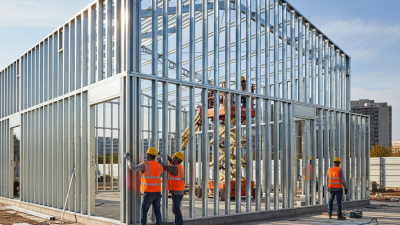
In practical projects, galvanized steel studs provide a stable framework for partitions, offices, studios, hotels, and industrial rooms. However, metal framing alone does not block much sound. Mineral wool within the cavity can reduce airborne noise, while acoustic boards and resilient connections help limit vibration. Continuous acoustic sealant around doors, floors, ceilings, and service openings is equally important.
Small gaps matter.
Reliable Chinese manufacturers should provide clear technical data, material specifications, installation drawings, and independent laboratory test reports. Buyers should check whether testing reflects the proposed wall assembly, not merely one attractive component. Factory experience also matters. Ask about forming accuracy, corrosion protection, quality control, packaging, and project references in similar climates.
The “best” wall is not always the thickest or most expensive option. It must match the target noise level, available space, fire requirements, moisture conditions, and installation skills. A supplier may offer impressive laboratory results, yet poor site workmanship can weaken the final barrier. This is an easy detail to underestimate.
There is no perfect system.
This guide examines practical selection criteria for Chinese soundproofing metal stud wall suppliers. It focuses on measurable performance, transparent documentation, and realistic installation conditions. Some recommendations may need adjustment after on-site testing, because building structure and workmanship can change the result.
What Are the Best Soundproofing Metal Stud Walls from China?
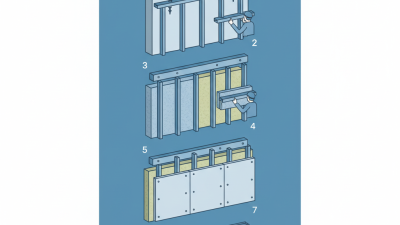
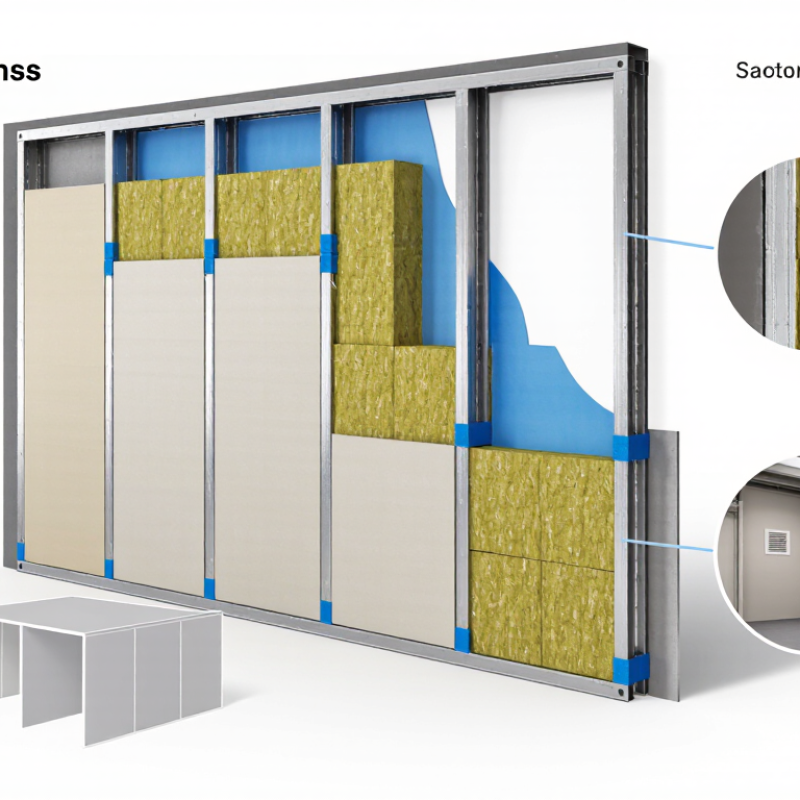
Soundproofing metal stud walls use galvanized steel tracks and studs to support acoustic layers. The metal frame itself does not block much noise. Performance comes from mass, absorption, airtightness, and decoupling.
A typical wall may include mineral wool inside the cavity, two gypsum board layers, and acoustic sealant around the perimeter. Resilient channels can reduce vibration transfer. The Gypsum Association’s GA-600 Sound Control Design Manual lists tested wall assemblies commonly achieving STC ratings from about 45 to 60. STC measures airborne speech and television noise, not every low-frequency sound. ASTM E90 and ASTM E413 are widely used for laboratory testing and classification. Real buildings can perform worse. Flanking paths through ceilings, floors, sockets, and door frames often reduce results.
Tips: Ask for full laboratory test reports, not only an STC number. Check stud thickness, board density, cavity insulation, and joint layouts. For Chinese production, inspect galvanized coating, straightness, and dimensional tolerance before shipment. Seal every edge carefully. One small gap can weaken a large wall.
A practical design uses staggered joints between board layers. Avoid placing electrical boxes back-to-back. Use independent framing where privacy requirements are demanding. This costs more space and labor. Still, it may outperform a thicker wall with rigid connections. I would question any claim promising “complete silence,” because construction noise always finds weak paths.
| Data Dimension | Typical Specification or Value | Why It Matters for Soundproofing | Practical Selection Guidance |
|---|---|---|---|
| Wall System Definition | A framed partition using galvanized steel studs and tracks, acoustic insulation, and one or more layers of gypsum board. | The complete assembly controls sound transmission; the metal studs alone do not provide effective sound insulation. | Evaluate the full tested wall assembly rather than selecting a stud profile in isolation. |
| Stud Material | Cold-formed galvanized steel, commonly produced from coated steel sheet. | Steel provides dimensional stability and non-combustibility, while the wall design must limit direct vibration paths. | Confirm corrosion protection, consistent dimensions, straightness, and compatibility with the board system. |
| Common Stud Widths | Approximately 50, เป็น? 64, 75, 92, or 100 mm, depending on the framing system. | Wider cavities can accommodate thicker acoustic insulation and may support higher-performing assemblies. | Select the width according to required wall thickness, insulation depth, services, and fire-rating requirements. |
| Typical Stud Thickness | Approximately 0.50–1.20 mm base metal thickness, depending on load and system design. | Thickness affects structural capacity and stiffness, but greater thickness does not automatically produce better acoustic performance. | Use engineering calculations and tested system specifications for load-bearing or tall partitions. |
| Wall Cavity | Usually a single cavity of about 50–100 mm; deeper cavities are possible in special systems. | The cavity separates the board layers and creates space for sound-absorbing insulation. | Avoid compressing the insulation; fill the cavity evenly without leaving uninsulated gaps. |
| Acoustic Insulation | Mineral wool or glass wool, commonly 40–100 mm thick, with a suitable airflow-resistivity range. | Porous insulation reduces sound energy inside the cavity and helps control resonance. | Choose insulation specifically intended for cavity-wall acoustic or building applications. |
| Gypsum Board Layers | Typically one or two layers on each side; boards are often 12.5 or 15 mm thick. | Additional mass generally improves airborne sound insulation, especially when joints are staggered. | Use acoustically rated or high-density boards where specified by the tested assembly. |
| Typical Overall Wall Thickness | Approximately 75–160 mm for common single-stud partitions, depending on layers and stud width. | A thicker, heavier, and better-separated assembly can provide improved sound isolation. | Balance acoustic targets with available floor area, door frames, junction details, and service routes. |
| Expected Airborne Sound Performance | Common tested laboratory values may range from about Rw 40 to 60 dB, or an equivalent rating under another standard. | The rating indicates resistance to airborne noise such as speech, television, and office activity. | Treat the value as assembly-specific; field performance is often lower because of flanking and installation conditions. |
| Double-Stud Configuration | Two separate rows of studs with independent board linings and a separated or enlarged cavity. | Greater mechanical separation reduces direct vibration transfer through the frame. | Consider this configuration for bedrooms, meeting rooms, studios, plant rooms, or other high-isolation applications. |
| Resilient Channels or Acoustic Clips | Flexible connection components installed between the framing and board lining. | They can reduce structural vibration transfer when correctly specified and installed. | Prevent screws from bridging the resilient layer into the framing, as bridging can significantly reduce performance. |
| Perimeter Sealing | Continuous acoustic sealant at floor, ceiling, wall junctions, board joints, and service penetrations. | Small air gaps can create direct leakage paths and substantially reduce acoustic isolation. | Use a permanently flexible sealant compatible with the board and substrate materials. |
| Fastener and Joint Treatment | Correct screw spacing, staggered board joints, taped joints, and sealed penetrations. | Poorly treated joints can create cracks, air leakage, and rigid vibration bridges. | Follow the installation method used in the acoustic test report or system specification. |
| Fire and Acoustic Coordination | Some wall assemblies are tested for fire resistance as well as sound insulation. | Changing board type, insulation, fasteners, or stud spacing can invalidate the tested fire and acoustic performance. | Use a complete tested configuration when both fire and acoustic compliance are required. |
| Relevant Test Information | Look for laboratory reports using standards such as ISO 10140, ISO 717-1, ASTM E90, or ASTM E413, as applicable. | Standardized testing makes results more comparable between wall assemblies. | Verify the test scope, specimen construction, rating method, and whether the report applies to the proposed installation. |
| Best Overall Selection Criteria | A complete, tested system combining suitable steel framing, cavity insulation, mass, decoupling, airtight detailing, and compatible accessories. | Soundproofing performance depends on the interaction of all components rather than on one material alone. | Compare verified test data, material consistency, technical documentation, production quality, packaging, and installation support. |
Note: Acoustic ratings are indicative ranges for common wall assemblies. Actual performance depends on the complete tested construction, workmanship, flanking transmission, openings, penetrations, and site conditions.