Leave Your Message

150mm Metal Stud 7 Buying Tips for Global Buyers?

Choosing a 150mm Metal Stud for an overseas project involves more than checking its listed width. Global buyers must compare strength, coating quality, dimensional accuracy, documentation, and delivery conditions. A stud that looks suitable on a screen may behave differently after months of storage or installation. Small errors can affect wall alignment, screw placement, and final project costs.

This guide presents seven practical buying tips for professional purchasers, contractors, and distributors. It considers steel thickness, galvanized protection, profile tolerances, load requirements, compatible tracks, packaging, and supplier verification. Buyers should request mill certificates, inspection records, product drawings, and samples before placing large orders. Clear evidence matters. A reliable supplier should explain manufacturing controls, testing methods, and quality responsibilities without avoiding technical questions.

Real projects also reveal less obvious concerns. Salt air, humid warehouses, long shipping routes, and rough handling can damage poorly protected materials. Packaging deserves attention. So does pallet stability. Buyers should confirm bundle quantities, labeling, container loading, and replacement procedures. No checklist is flawless. Even experienced teams can overlook local installation practices or changing site conditions. That is why a small trial order can be valuable before full production.

The right decision balances engineering needs, total cost, delivery reliability, and future maintenance. Cheap material is not always economical. A documented comparison helps prevent rushed purchasing and unsupported assumptions. With careful questions and realistic inspections, global buyers can select a 150mm Metal Stud that performs consistently across different climates, construction systems, and project expectations.

150mm Metal Stud 7 Buying Tips for Global Buyers?

Understanding 150mm Metal Stud Dimensions and Applications

Understanding 150mm Metal Stud Dimensions and Applications

A 150mm metal stud usually describes the nominal web depth, not the complete profile. Actual dimensions may include a 35–50mm flange and a return lip. Gauge commonly ranges from 0.60mm to 1.60mm, depending on load and fire requirements. Tolerances differ between suppliers, so request certified dimensional drawings before ordering. EN 14195 covers European framing components, while ASTM C645 guides nonstructural steel framing in North America.

For global buyers, check seven details:

web depth flange width steel thickness coating mass yield strength hole pattern pack length

Perforated webs can simplify cable routing, but excessive openings may reduce capacity. A 150mm stud suits high-performance internal partitions, service walls, shaft enclosures, and some external infill systems. It should not be treated as load-bearing without structural calculations. Field experience shows that a deeper stud can improve cavity insulation, yet poor junction detailing still causes sound leakage.

UNEP’s 2023 Global Status Report states that buildings and construction consume about 34% of global energy and create around 37% of energy-related and process emissions. Lightweight framing may reduce site waste and transport weight, but its environmental value depends on recycled content, corrosion protection, and regional logistics.

Do not rely on catalogue claims alone. Ask for mill certificates, fire-test evidence, acoustic test results, and coating documentation. I have seen projects specify “150mm” without defining the gauge. That small omission created procurement delays and costly redesign.

Checking Steel Grade, Thickness, Coating, and Corrosion Resistance

150mm Metal Stud: 7 Buying Tips for Global Buyers

When sourcing a 150mm metal stud, begin with the steel grade, not the lowest quotation. Ask for the mill certificate and confirm yield strength, tensile strength, and chemical composition. A dependable supplier should explain whether the grade suits load-bearing or partition work. Do not accept “high quality” as evidence. Request samples and compare stamped markings with the paperwork.

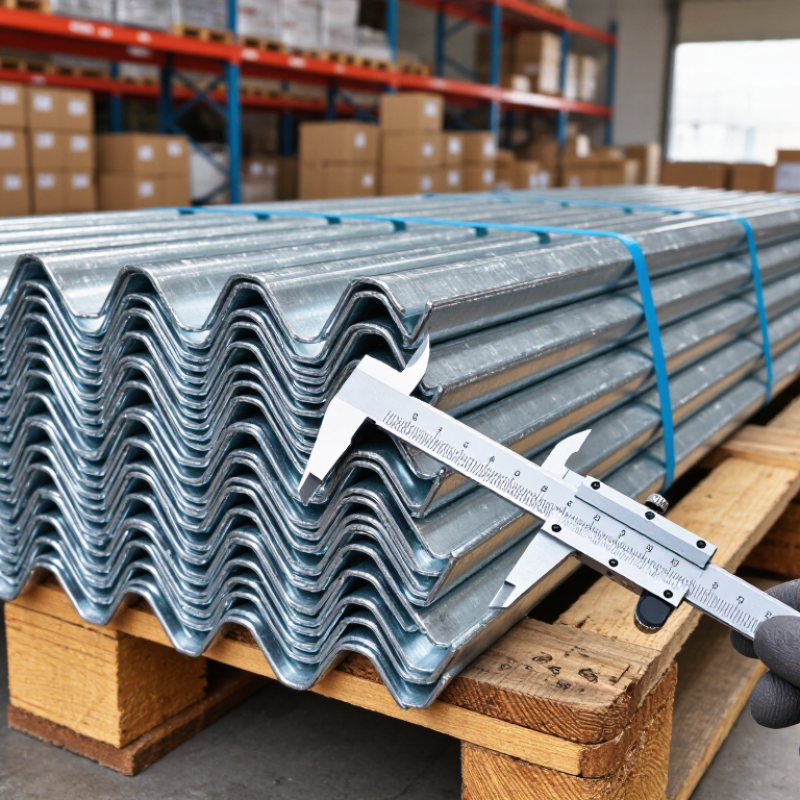
Thickness is the next practical check. Measure several points with a calibrated micrometer, including the flange and web. Nominal thickness may exclude the coating, so clarify the stated basis before comparing offers. Even a small reduction can affect screw grip, deflection, and fire-rated assembly performance.

I have seen drawings specify 0.75 mm while delivered sections feel noticeably lighter. That gap deserves a written explanation. Do not guess.

Coating selection should reflect the building’s exposure. Indoor, dry rooms may need less protection than humid factories, coastal storage areas, or transport routes with salt air. Confirm the zinc coating mass or equivalent designation, test method, and cut-edge treatment. Inspect for bare spots, white rust, sharp burrs, and damaged bundles. Ask how long the material stayed covered after galvanizing. Corrosion often begins early. A salt-spray result alone can mislead because it cannot recreate every project environment. Keep batch records, photographs, and a retained sample. Supplier answers should be specific, although some technical details may still require independent verification.

Comparing Load Capacity, Fire Ratings, and Acoustic Performance

150mm Metal Stud Buying Tips for Global Buyers: Comparing Load Capacity, Fire Ratings, and Acoustic Performance

A 150mm metal stud is not automatically a heavy-duty framing member. Its load capacity depends on steel thickness, yield strength, stud spacing, bracing, and connection quality. Check tested load tables, not only product dimensions. A thicker gauge often supports higher loads, but it can also increase shipping weight and installation effort. I have seen projects specify strong studs but use weak tracks and poorly fixed anchors. The frame then performs below expectations. Deflection limits matter, especially around doors, ceilings, and large wall panels.

Fire performance requires a complete tested wall assembly. The stud alone does not provide a reliable fire rating. Review the exact combination of boards, insulation, fasteners, joints, and service penetrations. Ask for test reports that identify the applicable standard and assembly thickness. Local approval requirements may differ between markets. Do not accept an unverified “fire resistant” statement.

Acoustic performance depends on separation and workmanship. A 150mm cavity can hold mineral wool insulation, but empty space may transmit speech and equipment noise. Double-layer boards, staggered joints, and resilient channels can improve results. Seal perimeter gaps carefully. Small openings around sockets can undermine a high-rated wall. Laboratory ratings are useful, yet site results are often lower. That gap deserves attention. Compare transmission ratings, frequency data, and installation details before ordering. Recheck assumptions with a qualified engineer when loads or fire risks are significant.

Verifying International Standards, Certifications, and Quality Control

For a 150mm metal stud, confirm the actual profile depth, flange width, thickness, and permissible tolerances. A drawing is safer than a sales description. Check whether the product follows EN 14195, ASTM C645, or another required standard. The correct standard depends on the project location and application.

Request the declaration of conformity and recent test reports. Review steel grade, yield strength, zinc coating, and corrosion performance. Ask for mill certificates linked to each production batch. Certification alone is not enough. Verify the issuing body and testing scope. An ISO 9001 certificate can support quality management, but it does not prove every stud meets your specification.

During supplier evaluation, inspect sample pieces for straightness, clean punch-outs, sharp edges, and consistent roll forming. Ask how gauges are checked during production. Reliable factories record incoming steel, tooling changes, dimensional checks, and final inspections. Request photographs, inspection records, and a traceable batch number. Independent pre-shipment inspection adds useful evidence, especially for unfamiliar suppliers. Protect the bundles from moisture during transport, because damaged coating may remain unnoticed under wrapping. I have seen paperwork look perfect while small dimensional errors caused installation delays. Recheck critical measurements yourself. No checklist is perfect. Allow room for technical review, because local building requirements and project conditions can expose weaknesses that documents miss.

150mm Metal Stud: 7 Buying Tips for Global Buyers — Verifying International Standards, Certifications, and Quality Control
No. Buying Dimension What to Specify for a 150mm Metal Stud Relevant International Reference Documents or Evidence to Request Incoming Quality-Control Check Common Risk or Red Flag
1 Confirm the actual section geometry Define the nominal web depth as 150 mm, then specify flange width, lip size, profile shape, overall length, punch-outs, and dimensional tolerances. A “150mm stud” normally identifies the web depth only; it does not fully define the section. ASTM C645 for nonstructural steel framing members; ASTM C955 where the studs are intended for load-bearing applications; EN 14195 for metal framing components used in gypsum board systems. Approved profile drawing, sectional dimensions, tolerance schedule, product data sheet, and a sample or first-article approval record. Measure web depth, flange width, lip length, overall length, hole position, and squareness with calibrated steel rules, calipers, and a measuring fixture. Compare results with the approved drawing. The supplier lists only “150 mm” without flange dimensions, gauge, tolerance, or an approved drawing. Excessive variation can cause poor board alignment and difficult installation.
2 Verify base-metal thickness and steel grade Specify whether the stated thickness is base-metal thickness or coated thickness. Define the required steel grade and minimum yield strength according to the project design. For structural applications, grade selection must be confirmed by a qualified engineer. EN 10346 for continuously hot-dip coated flat steel products; common European designation examples include DX51D for forming steel and higher-strength grades such as S280GD or S350GD when specified. ASTM A653/A653M is commonly used for galvanized sheet steel in North American specifications. Mill test certificate showing heat or coil number, steel grade, nominal thickness, mechanical properties, and coating designation. Request traceability from the certificate to the production lot. Verify thickness at several locations away from edges and holes using a calibrated micrometer. Review the certificate and, when required, conduct tensile testing through an accredited laboratory. Thickness is measured only on the finished coating, the certificate uses an unapproved grade, or the reported strength values cannot be traced to the supplied coil.
3 Check corrosion-protection requirements Specify the coating type and minimum coating mass or thickness. Galvanized coating designations such as Z120 or Z275 under EN 10346 represent total coating mass on both sides in g/m²; the correct value depends on the environment and project specification. EN 10346 for continuously hot-dip coated steel; ASTM A653/A653M for galvanized sheet coating designations; ISO 1461 is generally associated with batch hot-dip galvanizing and should not automatically be substituted for coil-coated sheet requirements. Coating designation, coating-mass or thickness test report, surface-treatment description, and environmental suitability statement. Salt-spray results should be treated as supplementary evidence, not as a direct replacement for coating specification. Check the coating by a suitable calibrated method, such as magnetic coating-thickness measurement or laboratory coating-mass testing. Inspect cut edges, punch-outs, scratches, white rust, bare spots, and uncoated areas. A generic statement such as “galvanized” is provided without coating designation or test results. Heavy white rust, exposed steel, or inconsistent coating can reduce service life.
4 Match the product standard to the application Decide whether the stud is for a non-load-bearing partition, ceiling system, shaft wall, exterior framing, or load-bearing wall. A 150mm profile must not be selected by size alone; design loads, span, deflection, fire, acoustic, and moisture requirements also apply. EN 14195 covers metal framing components for gypsum board systems. ASTM C645 covers nonstructural steel framing members, while ASTM C955 covers load-bearing steel framing members. Installation references may include ASTM C754 for nonstructural framing. Declaration of performance or product conformity documentation where applicable, technical datasheet, load tables, fire or acoustic system test reports, and installation instructions for the intended system. Confirm that the product category, thickness, grade, and test configuration correspond to the intended wall or ceiling assembly. Review the complete system rather than approving the stud in isolation. A nonstructural stud is marketed for load-bearing use without design data, or a fire-rating claim is made for the metal profile alone instead of the complete tested assembly.
5 Validate certification and market-access claims Certification must identify the exact product scope, manufacturing site, standard, certificate holder, validity period, and certification body. ISO 9001 demonstrates a quality-management system; it does not by itself certify steel grade, dimensions, or structural performance. For European construction-product markets, verify whether the specific product and intended use fall under the Construction Products Regulation and whether a Declaration of Performance and CE marking route applies through the relevant harmonized standard. Local building regulations may impose additional requirements. Certificate PDF issued by the certification body, certificate number, scope, validity, audit status, Declaration of Performance when applicable, and product-label photographs showing batch or lot identification. Confirm certificate details directly through the issuing body’s public verification system or official contact channel. Check that the certificate scope matches the supplied profile and production location. An undated logo, unverifiable certificate number, certificate issued for a different product, or an ISO 9001 certificate presented as proof of product compliance.
6 Audit manufacturing and process control Review coil identification, roll-forming setup, tooling maintenance, straightening, cut-to-length control, punch-out accuracy, packaging, and nonconforming-product control. Ask for the inspection frequency and acceptance criteria. ISO 9001 can provide a framework for quality-management processes. Test and measurement methods should be stated in the purchase specification and aligned with the applicable product standard. Process-flow chart, control plan, inspection records, calibration certificates, corrective-action records, internal audit summary, and a sample batch traceability report. Conduct a pre-shipment inspection or independent third-party inspection. Sample multiple bundles and production locations rather than checking only one visible piece. No lot traceability, expired calibration records, undocumented rework, uncontrolled tooling changes, or inspection records that contain no actual measurements.
7 Control packaging, logistics, and final acceptance Agree on bundle quantity, maximum bundle weight, protective separators, moisture protection, labeling, Incoterms, loading method, and storage instructions. Long 150mm studs must be protected from bending and telescoping during transport. Use the agreed contract specification together with applicable packaging, workplace-safety, and import requirements in the destination country. For international shipment, ensure labels and shipping documents identify profile, length, quantity, batch, and country of origin accurately. Packing list, commercial invoice, certificate of origin when required, loading photographs, bundle labels, inspection release note, and a written claims procedure with defined acceptance tolerances. Inspect bundle count, random lengths, straightness, surface condition, labels, moisture damage, edge deformation, and conformity between packing documents and physical goods before signing final acceptance. Bundles are overloaded, exposed to trapped moisture, poorly supported, unlabeled, or shipped without a documented procedure for shortages, damage, or out-of-tolerance material.

Evaluating Suppliers, Pricing, Packaging, Shipping, and After-Sales Support

For global buyers, choosing a 150mm metal stud requires more than comparing online quotations. Ask suppliers for mill certificates, steel grade, thickness tolerance, coating details, and production photos. A reliable supplier should provide a physical sample before mass production. Check whether the stud remains straight after cutting and whether the track fits without excessive force. Small fitting problems can delay an entire installation.

Price needs a wider calculation. Include tooling, inland transport, export packing, freight, insurance, taxes, and destination handling. A low unit price may hide weak packaging or unstable steel thickness. Request a clear quotation based on identical specifications, quantities, and delivery terms. Compare pallet strength, bundle count, and loading efficiency. A well-packed bundle should use edge protection and moisture-resistant wrapping. It should survive long handling, not just leave the factory neatly.

Shipping performance depends on preparation. Confirm production lead time, container loading photos, bundle labels, and document accuracy. Ask how the supplier manages port delays or partial shortages. After-sales support matters when a bundle arrives damaged or measurements vary. Require batch records, inspection reports, and a named contact for claims. Keep samples and photographs for comparison. My own caution is simple: a confident sales promise is not proof. Even experienced buyers can overlook packaging space, seawater exposure, or local unloading limits. Leave room for correction.

150mm Metal Stud: 7 Buying Tips for Global Buyers

The chart shows the theoretical steel mass per metre for a 150mm-wide flat strip at representative thicknesses. Values use a steel density of 7,850kg/m³ and the formula: width × thickness × density. Finished metal studs may weigh more because of profile geometry, lips, perforations, coating, and packaging, so buyers should confirm the actual unit weight before comparing prices, freight, or minimum-order quantities.